
Why We Need Anal Cancer Screening
Anal cancer is preventable, yet thousands of people are diagnosed with it each year. That can change with awareness, open conversations, and access to screening.
Before cancer develops, early cell changes can form in the anal canal. These are called high-grade squamous intraepithelial lesions (HSIL). These pre-cancerous changes usually cause no symptoms. This means people often don’t know they are at risk.
HSIL, or anal precancer, can often be found early. However, until recently, few providers – and patients – knew there were tests to find these cells before they turn into cancer. The International Anal Neoplasia Society (IANS), a close partner of ACF, developed a screening protocol to find these early precancerous changes.
IANS also made an Anal Cancer Prevention Screening Toolkit. This toolkit helps make these screening tools more widely known and easier to use. This is the first time there are consensus comprehensive international screening guidelines for preventing anal cancer
Why IANS created an Anal Cancer Prevention Screening Toolkit
Even though anal cancer screening works, it has long faced challenges because systems and conversations have lagged behind science.
- Limited access: There are still too few trained specialists who can perform HRA
- Recent evidence: It was only in 2022 that research confirmed that treating HSIL prevents cancer
- Uneven adoption: Not all countries or clinics have started screening yet
- Stigma: Anal health, HPV, HIV, and sexual health are often left out of routine medical conversations
Even today, many patients only learn about screening if they ask about their anal health themselves.
The Anal Cancer Prevention Screening Toolkit
To help close this gap, the International Anal Neoplasia Society (IANS) created the Anal Cancer Prevention Screening Toolkit.
This toolkit is about turning knowledge into action.
It offers practical, real-world guidance for:
- Healthcare providers starting screening programs
- Clinics improving existing services
- Advocates working to expand access
- Patients and community members seeking to better understand anal cancer risk, screening options, and follow-up care
The information provided in the toolkit is based on the IANS consensus guidelines. The IANS guidelines use the latest research to recommend who should be offered anal cancer screening and how they should be screened. The toolkit also offers guidance to providers on how to handle abnormal screening results using the screening tools available today.
What this means for patients
For individuals, the toolkit is a starting point.
It can help you:
- Understand if you may be at higher risk
- Know what screening options exist
- Feel prepared to talk with your provider
- Take an active role in your health
Screening decisions should always be made with a healthcare provider, based on personal risk and local availability.
I've lost friends who might still be alive today if they had gotten diagnosed earlier. That's why I'd really like to see some more information about getting screened if hemorrhoid-type symptoms persist for more than a few weeks. It's great that everybody is working hard to get the word out and wonderful to see the information gathered together for both doctors and the general population. Thank you! – Falline, anal cancer thriver
What are the symptoms that should prompt screening for anal cancer?
The Anal Cancer Prevention Screening Toolkit was created to promote screening for people who do not have symptoms but are at higher risk for anal cancer. This higher risk can come from multiple factors, including a weakened immune system or past exposure to human papillomavirus (HPV).
Screening for anal pre- is a similar preventative approach as screenings for skin cancer, cervical cancer, and colorectal cancer. In these screenings, providers look for pre-cancer or cancer before the patient has symptoms.
However, if you have symptoms, please see a doctor immediately and ask to be screened. Symptoms of anal cancer can include bleeding, pain, pressure, a lump or growth, itching, swollen lymph nodes, hemorrhoids that do not go away despite treatment, or a change in bowel habits.
How is a person screened for anal cancer?
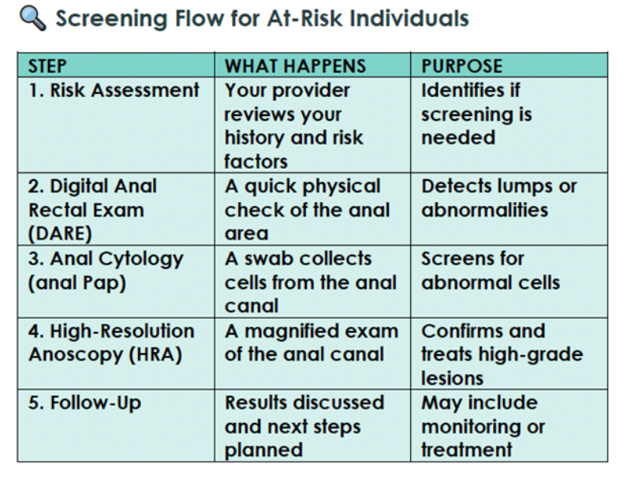
The goal of screening is to find and treat anal precancer spots before they turn into cancer. There are two steps to screen for anal pre-cancer.
In the first step, a person is screened with a simple, quick anal swab. The swab looks for abnormal cells caused by human papillomavirus (HPV). HPV is the virus that causes most anal cancers. Your provider may call this test cytology. In some settings, an anal swab may also be tested for HPV DNA as part of screening, although it is not yet available everywhere.
If the swab results are abnormal, the next step is a test called High-Resolution Anoscopy (HRA). This test lets providers look closely at the anus. During this test, the provider may take small samples called biopsies. If HSIL is found in the sample, your provider will often treat it right away.
Another important exam is the digital anorectal examination (DARE). In this exam, a provider gently checks the area with a gloved finger. This simple step can find anal cancer early. It cannot find anal pre-cancer. If cancer is found, you will be sent to a cancer care team for more care.
Anal swab screening should only be done in settings where follow-up HRA and treatment are available for people with abnormal results. In settings where HRA is not available, DARE remains an important tool for finding anal cancer early.
Screening is not complicated—but access and awareness are still catching up
Who performs anal cancer screening?
The first step in screening is an anal swab and a digital anorectal examination (DARE). This step can be done by primary care providers, gynecologists, HIV providers, colorectal surgeons, gastroenterologists, or other specialists.
The second step happens only if your anal swab results are abnormal. If the swab results are abnormal, you'll be referred for HRA, which is usually done as an outpatient procedure. HRA uses a special magnifying instrument called a colposcope to look at the anal canal. It must be done by a provider trained in the procedure. Training in HRA isn’t limited to one specialty. The providers trained in it are most often colorectal surgeons, infectious disease doctors, gastroenterologists, or gynecologists.
At this time, there is no comprehensive public directory of providers who perform HRA, and availability varies by location. IANS is developing a list of providers who have taken the HRA training. When that is complete, it will be available here.
Before making an appointment for HRA, confirm that the provider is trained in HRA and treating anal precancer.
A shared goal: prevention
We have the tools to prevent many cases of anal cancer by detecting pre-cancerous cells. Now we need awareness, access, and conversation.
By reducing stigma, supporting providers, and empowering patients, we can move from late diagnosis to early prevention and save lives.
“HPV awareness, vaccinations and treatment protocols need to be part of the universal standard of care to all people. Health screening for HPV must be implemented in STI testing for a complete screening. It is far less expensive to provide education, vaccination, testing and follow up. The collateral damages from clinician oversight and lack of knowledge is not just financial, but detrimental to the patient and their health outcomes.” – Kevin, anal cancer thriver
Graphs from the Toolkit
The following graphs are illustrations of the IANS Consensus Guidelines for Anal Cancer Screening.
In-Office Screening Procedure
This chart shows part of the IANS guidelines for anal cancer screening. It lays out the steps doctors should follow to check for anal cancer and precancer.
Populations to Proactively Screen for Anal Cancer
Screening to prevent anal cancer works like other cancer screenings you may know about, such as those for skin cancer, cervical cancer, and colon cancer. In all of these screenings, doctors check for pre-cancer or cancer before a person feels sick or notices any changes.
The chart below comes from new expert medical guidelines to prevent anal cancer. These are the first set of consensus screening guidelines for anal cancer ever developed and were published in 2024. They are called the IANS Consensus Guidelines for Anal Cancer Screening.
The chart below shows which groups of people are at higher risk and explains when and how they should be screened. One thing to remember: regardless of your position on this chart, if you feel something is wrong, see a doctor right away.
The left side of the chart lists people who are asymptomatic but still have a higher chance of developing this cancer. People in Group A have the highest chance and should be checked once a year. People in Group B have a smaller chance, but it's still higher than normal. They should talk to their doctor and decide together if they need to be checked, and how often.
The right side of the chart shows what happens during screening.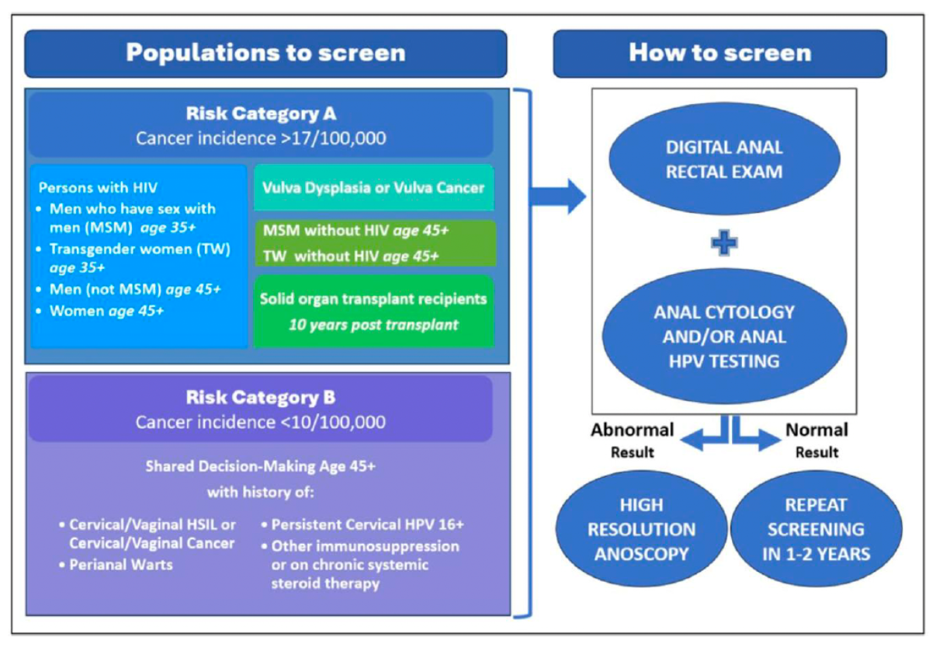
References:
Stier EA et al. IANS consensus guidelines for anal cancer screening. Int J Cancer, 2024.
IANS Anal Cancer Prevention Screening Toolkit, accessible at https://iansoc.org/Anal-Cancer-Screening-Tool-Kit