
PART ONE
Breaking It Down
 My name is Paige Golden, and I have a Golden Rule to share:
DON’T GET ANAL CANCER
or any of the other HPV related cancers such as cervical, some cancers of the vulva, penis and back of the throat, esophagus, and tonsils. There is a highly effective vaccine that has been expanded to include women and men up to 45 years old. So please, investigate this vaccine to see if it is appropriate for you or someone you love. Take it from one who has endured multiple radiation treatments: when radiation meets the place where you speak, swallow, eat, and I’m not going to spell out the bodily functions below the low-rise belt … you want to avoid it.
Though some patients progress through treatment relatively unscathed, I still find it difficult not to mourn my losses--even after years of being cancer-free. And I especially cringe when labeled a survivor (I’m no fan of labels, in general, unless it’s something along the lines of Happy Fun Paige). Yes, I want to be like the triumphant people you see in the cancer marketing ads celebrating their survivorship. Yes, I’m grateful to be alive. I was grateful to be alive prior to my health crisis. And I can’t help but feel that I am NOT so lucky when repeatedly being reminded by perfectly healthy people how fortunate I am. But I haven’t given up. I want to be like those jubilant survivors, which is my motive for inviting you to follow my journey of reinvention. I’m no role model. I’m a work in progress.
My goal is not to scare; I’m a storyteller with a crafted tale about the gifts that emerge when life goes very dark.
And I have multiple insights to share. My first and forementioned: protection of others. My second is more personal: to transform the PTSD of my health detour to PTG. Post traumatic growth describes the experience of positive change resulting from the struggle that accompanies a major life crisis. In my case, the damage caused by radiation was career ending, ominously sexually threatening, and emotionally crushing. First, I will address the end of my career.
The physical demands of my former career in medicals sales became incompatible with my new normal—post radiation. Hint: What do the following careers have in common?
- lineman- as in the one from Wichita that restores power after a storm--although I imagine this might be equally daunting in the line of scrimmage
- flight attendant
- pharmaceutical/ medical representative
Answer: All are unsuitable careers for those in need of an unoccupied bathroom in a moment’s notice.
Although I was told early in my search for a life-saving diagnosis that the results of my treatment would be the end of my twenty plus year career, I was in complete denial. No, that couldn’t happen to me. As healthy as I am? Not a chance. I was wrong. While the cancer failed to take me down, the treatment killed the only career I’d ever known--and along with it a large part of my self-worth. Work afforded me purpose, meaning, identity, income, and connections. Retirement, for those fortunate enough to choose the timing, is a cause for celebration.
Conversely, being retired, by forces outside of one’s control, is nothing to commemorate--and a difficult concept for the working world to conceive. So much so, I avoided social situations for years--just too painful. No longer could I take the congratulatory comments about my non- working status.
That was until I came up with a storyline to clarify my forced retirement. (BTW: a light- hearted, well-rehearsed narrative works like a soothing balm when it comes to answering questions that jab at your sensitivity.) My explanation to the ubiquitous question of why I’m not returning to work said with a wink and a smile, “Being a post-pelvic radiation patient, I’m required to change my eating habits—just too risky to leave my home until the latter morning hours or until I know it’s ‘safe’. You are not in harm’s way, now. But take this as a warning: If you are ever in my presence in the early morning hours and get between that bathroom door over there and me, I will run you over like a Crimson Tide linebacker. And if we both must go, we can battle it out.” This usually invokes a smile, a chuckle, or even an entertaining story of commiseration. But the absolute best response I ever received was a poem shared by a woman on my birthday—and what a gift this was to me. Her response, “Oh, that happened to me on a first date, and I wrote a poem about it”. She proceeds to retrieve her phone and read:
Had a date today
And I sharted on the way It wasn’t till I stood up
That I said, “Oh, fuck!
This can’t be real
The way my panties feel (This is how it began.)
It’s impossible for me to express the hilarity, appreciation, and gratitude I felt towards this woman for commemorating her experience with such humility and joy. She normalized the shame associated with my plight. And I felt there must be others, like me, who would find her self-deprecating and self-defecating brand of humor inspirational. So, I asked her permission to use her poem to start something bigger. Jokingly, I referred to her as my Sharties (rhymes with parties) Angel. And from this exchange the idea for this compellation of short stories and poetry began to take shape.
Then there was the sexual threat posed by pelvic radiation. I did eventually make peace with my different physicality. But the pain of radiation burns was easier to endure than the emotional pain of not knowing the sexual aftereffects.
Three years post-treatment, I wrote a response to a New York Times article about the sexual dissatisfaction left in the wake of cancer.
My response ran digitally over a week. It even ranked Third Choice Editor’s Pick.
Normally, (though I’ve never been accused of being normal) I would have been over the moon to have my pithy comments recognized by such an institution.
In this case, maybe not, though it was satisfying to have my feelings validated.
Notice I chose to be anonymous, using my middle initial, D—as not to be recognized-- exemplifying the shame and stigma I felt associated with sexual dysfunction—of any kind. Combine that with cancer of the anus, associated with an STD.
I took this screenshot the hour it posted.
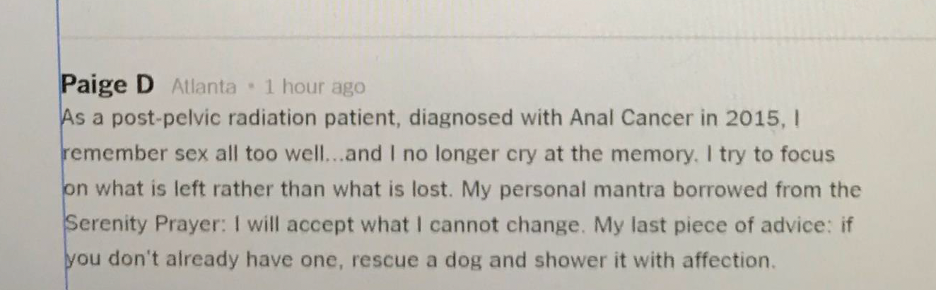
I’m pleased to report my love life has progressed to include more than my rescue dog, McGee.
The healing process after radiation and chemo is lengthy. In my case, pelvic radiation can and did lead to vaginal stenosis, the shortening and narrowing of the vagina, making sexual penetration challenging and frightful, but possible. And of the limited treatment options I found to be helpful: pelvic floor therapy and estrogen therapy, neither provided the magical cure-all I hoped for.
But I did promise to share gifts uncovered on my pathway to reinvention. This one I found out of necessity, though this sexual practice, as known in the western world, was first written about in 1931. “The Karezza Method”, a book by sex therapist William Lloyd, expounds a sexual practice related to the tantric approach of weaving the physical with the spiritual.
Karezza (pronounced ka-RET-za) is the Italian word for caress. It involves sensual play, slow touching, a focus on love rather than passion, closeness, bonding, relaxation, and unity. There are no rigid rules to follow. Simply put: the goal is not on the destination to orgasm, but on the journey of reaching a relaxed state of union with your partner to prolong and slow down the experience.
And it does not necessitate the upending of one’s sex life due to cancer to convert to this practice. However, I found it to be particularly meaningful, for those of us struggling to make a comeback into the world of sexuality. My partner and I found it intuitively. It didn’t require a manual, though there is plenty of available updated information on Karezza for those seeking instruction.
After a couple of years of knowing this new and improved brand of sexuality, the man in my life posed a question that gave me pause. He worded it in an exaggerated way that made me laugh. What he said was somewhat along the lines of did I ever miss being drilled like a jackhammer (something I could now not dream of tolerating). After hesitating, I admitted I missed the way I used to be. Feeling a bit inadequate, I asked him the same question. He responded that in no way did he feel there was anything missing and that he found our intimacy more than satisfying. “Besides”, he expressed, “there are even some advantages to your Penis Fly Trap”.
When I finally stopped laughing, I couldn’t help but wonder, was he sincere, or were his comments said to make me feel better?
Either way. It worked.
I feel compelled to point out how fortunate I was to have lived in a metropolitan area with outstanding medical professionals and facilities that did not require the need to travel outside of my home state for treatment. Moreover, my radiologist and oncologist (at Piedmont Cancer Center in Atlanta, Georgia) went above and beyond in discussing risks, consequences, options, and referring me to appropriate resources. Unfortunately, all too often, this is not the case when it comes to treating the ramifications, healing, and treatment for women’s sexual health. As a former women’s health representative, I’m all too familiar with the inequities of gender parity when it comes to women’s sexual health (gender parity being defined as the measuring stick ensuring men and women have equal access to resources, opportunities and rights). Bottom line: Sexual health is an important component of overall physical and mental well-being for both sexes.
And lastly, before leaving the sex topic, I’ll address the elephant in the room.
Is Anal Cancer Caused by Anal Sex?
With 90% of anal cancer cases believed to be caused by HPV, it is an obvious possibility. My cancer was discovered due to scar tissue from a previous surgery not healing properly. I will never know the singular cause of my disease, nor does it concern me. (I admit to being delightfully entertained even comforted by the cascade of butt jokes and accusations that came my way.) However, this false and frequently judgmental assumption continues to be an understandable source of shame and stigma for many. Therefore, in hopes of clarifying this erroneous belief, I am going to paraphrase the way my doctor explained it to me--while borrowing lyrics from Neil Diamond’s Sweet Caroline:
“Hands, touching hands, reaching out, touching me, touching YOU--hold 7 more counts," fondling hands exploring the entire erogenous genital landscape— that’s all it takes.
Besides, from what I’ve gathered from the popularity of this posed question: anal sex is far more mainstream than many believe. Moreover, if this practice is something you care to protect, please check out the vaccine.